
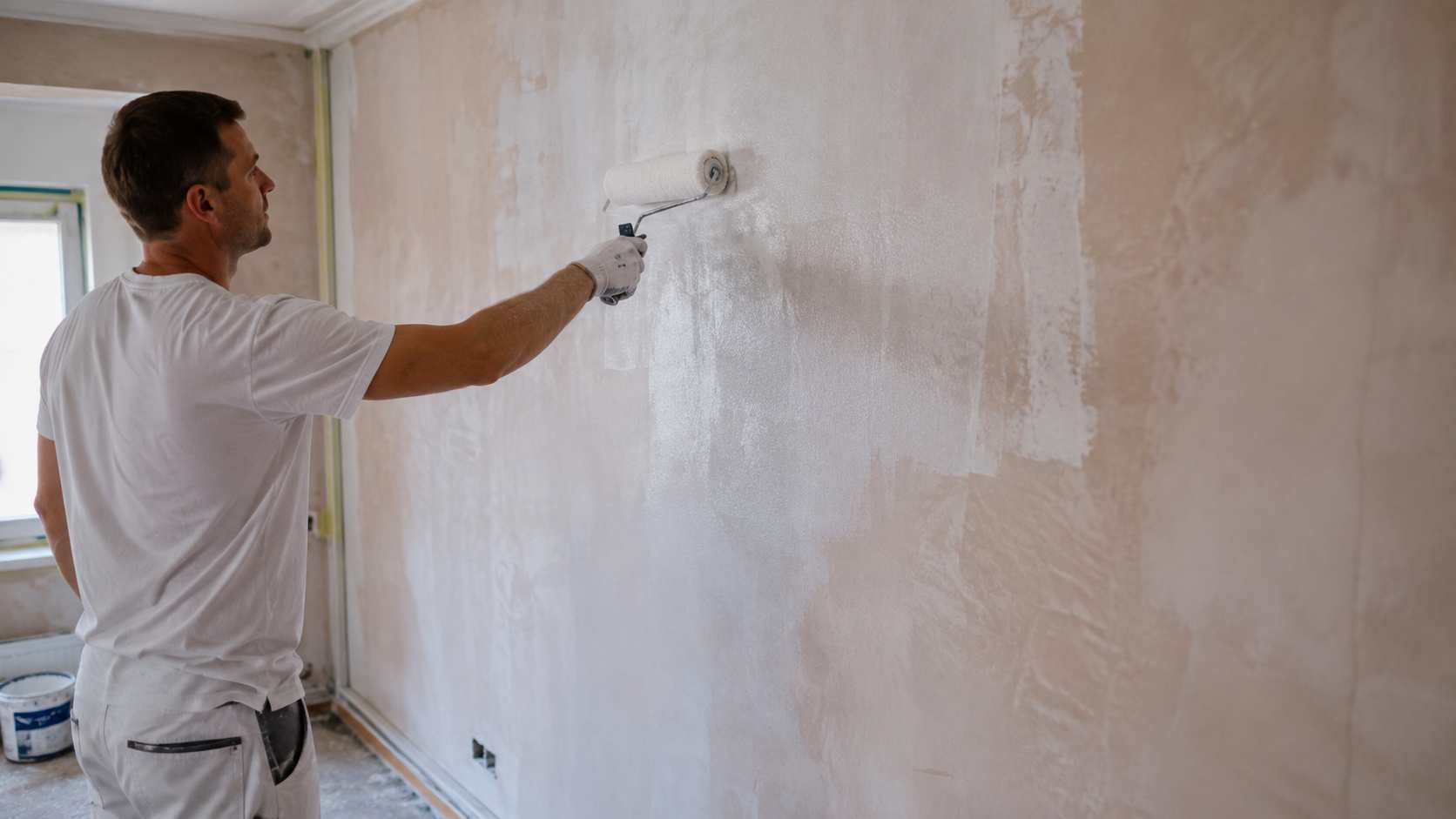
Newly plastered walls are one of the few situations where getting the first coat wrong is genuinely difficult to recover from. Paint applied at full strength onto fresh plaster often looks perfect for months before failing, and the fix at that stage involves scraping the whole lot back off.
Why can you not just paint straight onto it?
Fresh plaster is extremely porous, and that porosity is doing something specific. When you apply undiluted emulsion, the plaster draws the water out of the paint almost instantly. The binder in the paint cannot flow into the surface as it should, so instead of soaking in and locking on, the pigment sits on top as a dry film with very little mechanical grip.
The result is a coating that is bonded to nothing but itself. It may pass a fingernail test at first and then peel away in large flexible sheets a year later, often coming off when you remove masking tape or a wall fixing.
What exactly is a mist coat?
A mist coat is a first coat of matt emulsion thinned with clean water, applied specifically to be absorbed rather than to look good. The dilution is usually between ten and thirty percent water by volume, with more thinning for a very absorbent surface.
It will look thin, streaky and patchy when it goes on, and that is entirely normal. Its job is to seal the plaster and give the following coats a consistent surface to bond to, not to provide colour or coverage.
Which paint should you use for it?
Contract matt emulsion or a basic trade matt is the right product. These are cheap, highly breathable and contain few additives, so they soak in as intended.
The products to avoid are just as important.
- Vinyl silk and soft sheen emulsions, which contain additives designed to resist water penetration
- Washable or scuff resistant matt, for the same reason
- Anything described as one coat, since these are formulated to sit on the surface
- PVA adhesive, an old shortcut that creates a sealed plastic layer paint struggles to grip
- Most primers sold for sealing, unless the tin specifically names new plaster
How long should plaster dry before painting?
Longer than most people want to wait. A skim coat on an existing wall typically needs at least a week in good drying conditions, and fresh plaster on new backing or over damp masonry can need considerably longer, sometimes four to six weeks.
The visual test is colour. Wet plaster is dark brown and dries to a consistent pale pink or buff. Uniform light colour across the whole wall, including the corners and the bottom edges where drying is slowest, means it is ready. Any darker patches mean moisture is still leaving, and painting over them traps it.
Warmth and air movement help. Gentle background heating and open windows dry a room far faster than a sealed room with a dehumidifier alone, though avoid blasting a newly plastered wall with direct heat, which can cause it to crack.
How much water should you actually add?
Start at around twenty percent water to eighty percent paint and adjust. Highly absorbent plasterboard and very fresh skim may take up to thirty percent. Mix thoroughly in a separate bucket rather than in the tin, so you keep the rest of the paint at full strength for later coats.
Some trade contract matts are formulated to be applied to new plaster without thinning at all. If the tin says so explicitly, follow that instruction rather than adding water anyway.
What comes after the mist coat?
Two full strength coats of your chosen finish, applied once the mist coat is properly dry, which usually means a few hours in a warm room. Expect the first full coat to still look slightly uneven, because plaster absorbs unevenly around joints and repairs.
If you plan to use a silk or a washable matt as the final finish, apply it over the sealed surface at this stage rather than as the mist coat. The order matters: seal with something cheap and breathable, then build the finish you actually want on top of it.