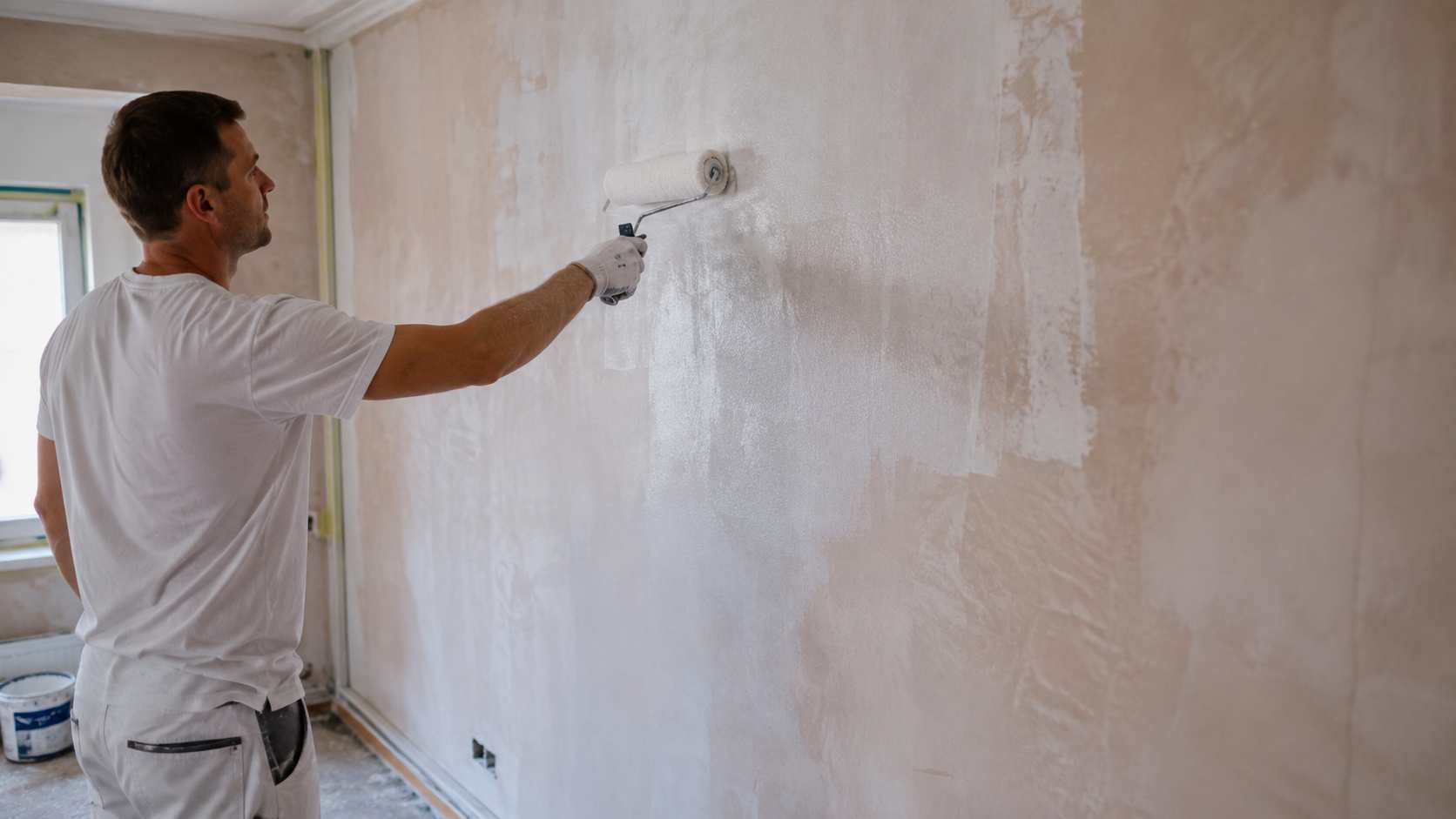
Paint drying and paint curing are two different processes, and confusing them is why a freshly decorated room so often ends up with a chair mark on the wall or a sticky window that has bonded itself shut. One takes hours and the other takes weeks.
What are the three stages?
Manufacturers generally describe drying in stages, each meaning something specific.
- Touch dry, when the surface no longer feels wet, typically one to two hours for emulsion
- Recoatable, when the film is stable enough to take another coat without lifting, usually two to four hours
- Fully cured, when the film has reached its final hardness and chemical resistance, which can take two to four weeks
Touch dry is the least useful of the three. A wall can feel perfectly dry while the film beneath is soft enough to mark with a fingernail or transfer onto anything pressed against it.
Why does curing take so long?
Water-based emulsion dries in two phases. First the water evaporates, leaving the binder particles packed together on the surface. Then those particles gradually fuse into a continuous film, a process called coalescence, and continue to harden as the last traces of solvent and water leave the film.
That second phase happens slowly and largely invisibly. It is why a wall painted on Saturday can be scuffed on Sunday by furniture that would not have marked it a month later.
What slows drying down?
Temperature and humidity are the two dominant factors. Most paints are formulated to be applied between ten and twenty-five degrees, and below that range the film forms poorly as well as slowly. High humidity is worse, because the air is already close to saturated and water cannot evaporate from the film into it.
Poor air movement compounds both. A sealed room holds a layer of humid air against the freshly painted surface, so opening a window slightly or running a fan makes a substantial difference. Thick application slows drying disproportionately, which is another argument for two thin coats rather than one heavy one.
What speeds it up safely?
Gentle warmth and moving air. Background heating at a normal room temperature combined with cross ventilation is the ideal, and a dehumidifier helps considerably in a damp room or during winter.
What does not help is direct heat. A fan heater aimed at a wall dries the surface far faster than the layer beneath, which can trap moisture, cause the film to crack, and on new plaster pull moisture through the paint. Sunlight through a window has a similar effect on one part of a wall, which is why decorators often work away from the sun.
When can you put the room back together?
Furniture can generally return the following day, provided nothing is pushed hard against a wall. Leave a small gap between furniture backs and painted surfaces for the first week or two, because prolonged pressure on a soft film causes the paint to stick to whatever is touching it.
Wall fixings, picture hooks and shelving are best left for a few days. Hanging heavy items on a wall painted that morning risks pulling the film rather than just the plaster.
Masking tape should come off much sooner rather than later. Removing it while the paint is touch dry but not fully hardened, ideally within an hour or two, gives the cleanest line. Tape left for days pulls the cured film away with it, taking chunks of your crisp edge.
How long before you can wash the walls?
Wait for the full cure, which for most emulsions means at least two weeks and ideally four. Washable paints in particular do not achieve their stated durability until fully cured, so cleaning a mark off a week-old wall can damage the very film that was supposed to resist it.
The same applies to bathrooms and kitchens. A newly painted bathroom benefits from being kept as steam free as practical for the first fortnight, and a kitchen wall should not be wiped down until the paint has had time to harden properly.