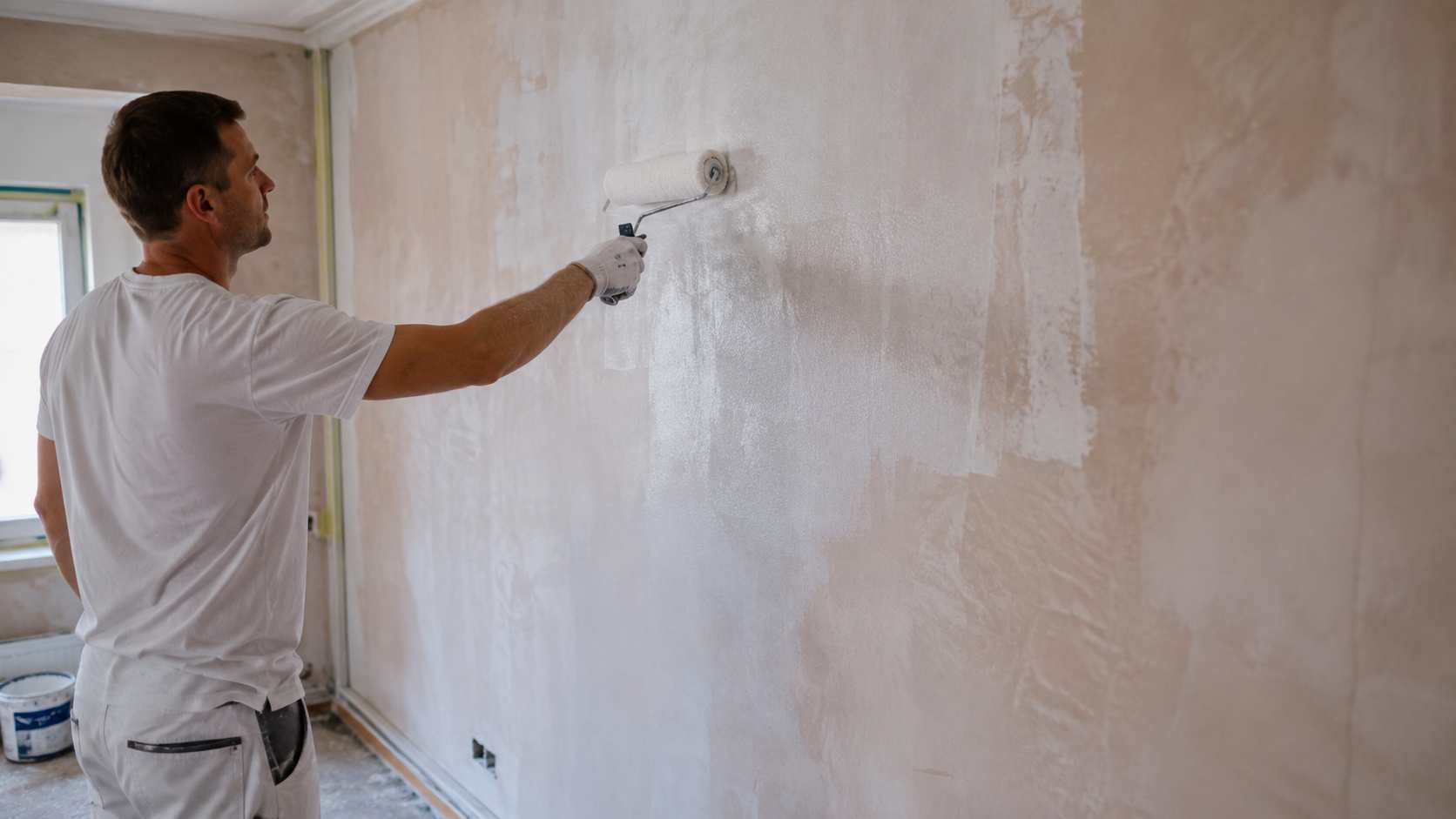
Paint that has peeled off an external wall is giving you diagnostic information rather than just creating work. The pattern of failure, where it has happened and what is underneath the loose flakes all point to a specific cause, and repainting without identifying it guarantees the same result in a year or two.
What is the most common cause?
Moisture behind the film, by a considerable margin. Water gets into the wall from somewhere, moves outwards, and pushes the coating off from behind. Since paint bonds to the surface rather than through it, even modest vapour pressure will lift a film that water cannot pass through.
The tell is usually location. Peeling concentrated below a gutter joint, beside a downpipe, around a window sill, at the base of a wall or in a patch on one elevation points to a specific water source rather than a paint problem.
Where is that water coming from?
- Leaking or blocked gutters and downpipes, the most frequent cause of all
- Cracked or hollow render letting rain in behind the coating
- Failed sealant around window and door frames
- A bridged damp proof course, often from a raised patio, path or flowerbed
- Defective pointing, allowing driving rain through the wall
- Painting a wall before it had properly dried after rendering or repointing
How do you tell adhesion failure from moisture?
Look at the back of a flake that has come off. If old paint or a chalky powder is stuck to the underside, the failure is between coatings, meaning the new paint bonded to a loose layer rather than to the wall. If the flake is clean on the back and the surface beneath looks sound, the coating has been pushed off, which indicates moisture.
The distribution helps too. Adhesion failure tends to be widespread and even across an elevation, because the whole wall was prepared the same way. Moisture failure is localised around the source.
What causes adhesion failure specifically?
Painting over a chalky, degraded coating without stabilising it first is the classic cause. Old masonry paint breaks down to powder under ultraviolet light, and new paint applied over that powder is bonded to nothing.
Other causes include painting over algae or lichen that was never treated, painting over dirt and dust, using an unsuitable coating such as interior emulsion, and applying paint in conditions too cold or too damp for the film to form properly.
Why does paint blister rather than flake?
Blistering is the earlier stage of the same moisture problem. Vapour lifts the film into a bubble which later bursts and peels. Blisters that appear soon after painting, especially on a sunny elevation, often mean the surface was damp when painted or the sun heated it enough to drive moisture out through a fresh film.
Small blisters containing water indicate a live moisture source. Blisters that are dry inside usually mean solvent or moisture was trapped during application. Either way the film must come off back to sound material.
How should you put it right?
Fix the cause first. Clear the gutters, replace the failed sealant, repoint the brickwork, lower the ground level, repair the render. Then allow the wall to dry, which after significant water ingress can take several weeks of decent weather.
Next, remove all loose material. Scrape and wire brush back until you reach coating that will not move under a scraper, feather the edges of the sound paint by sanding so the transition is not visible, and clean the surface thoroughly. Treat any algae with a fungicidal wash.
Then apply a stabilising solution if the remaining surface is at all chalky, spot prime bare patches, and finish with two full coats of a quality masonry paint. Patching a small area rarely looks right, so it is usually better to take the repair out to a natural break such as a corner, a downpipe or a change of level, and paint that whole section.