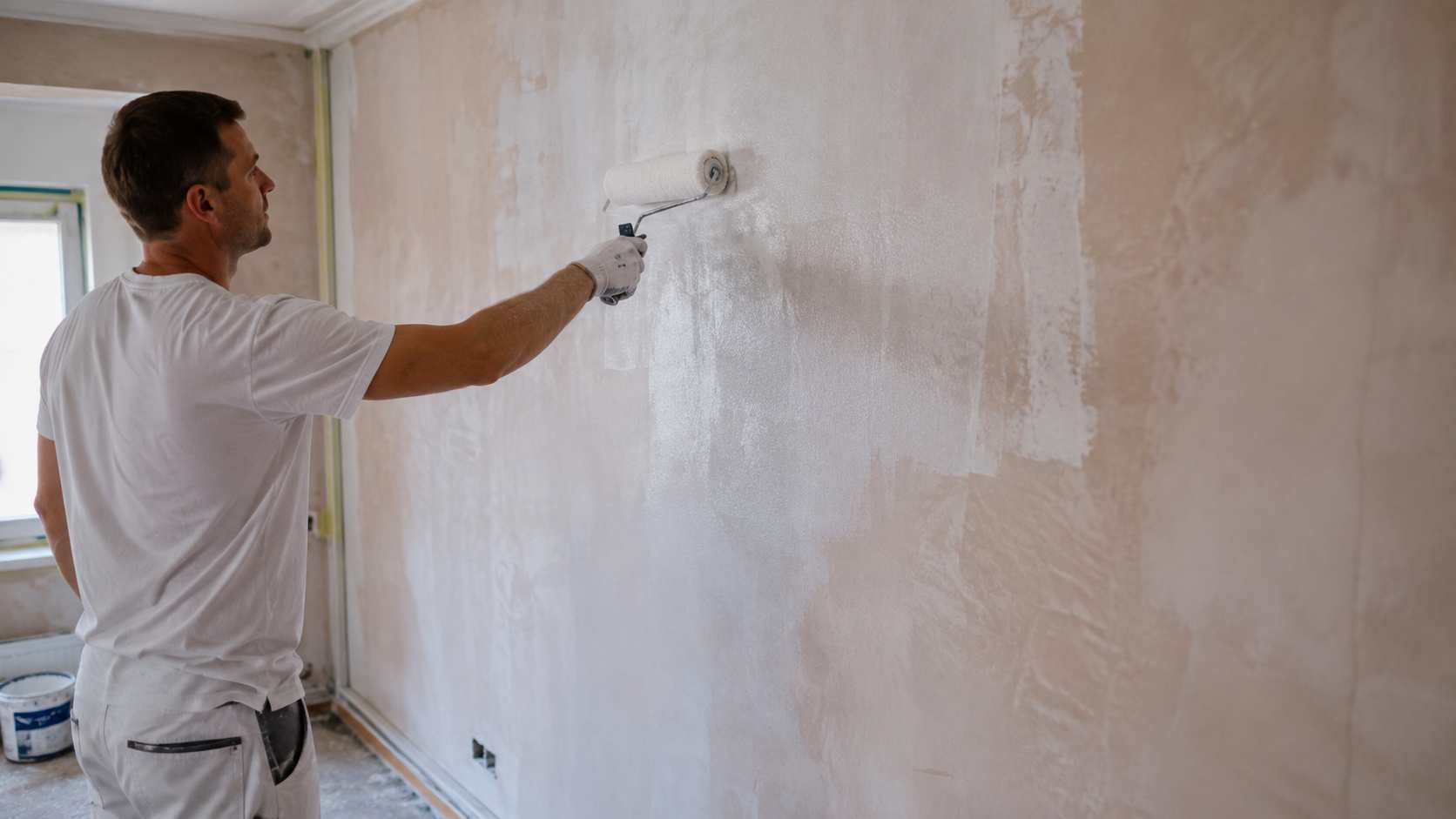
Painting a light colour over a dark one is the coverage problem that most often defeats people, and it is where the difference between paints becomes obvious. Three coats of a cheap white over a navy wall can still show a shadow, while a properly specified system gets there in two.
What makes a paint opaque?
Opacity comes primarily from pigment, and in white paints that means titanium dioxide. It is the most expensive raw material in the tin, and the amount included is the single biggest difference between a paint that covers and one that does not.
Cheaper paints reduce the titanium dioxide and substitute extenders such as chalk and clay. These bulk out the film without providing much hiding power, which is why very cheap white emulsion feels thin, looks translucent when wet and needs an extra coat to reach the same result.
Do one coat paints really work?
Sometimes, within limits. They are formulated with high pigment loading and a thicker film build, and on a modest colour change over a sound surface they can genuinely finish in a single application.
Over a strong dark colour they generally cannot, whatever the tin says. The claim is usually tested on a standard grey reference substrate rather than on a wall that has been aubergine for a decade. Treat them as products that may save you a coat rather than products that guarantee one, and buy an extra tin on the assumption that a second coat will be needed.
Why does a tinted basecoat work better than extra coats?
Because the job of hiding the old colour and the job of delivering the new one are separated. A basecoat in a mid grey or a shade related to your finish colour has one purpose, which is to obliterate what is underneath, and basecoat products are formulated for exactly that.
Your finish coats then only need to establish colour and sheen over a uniform base, which they do easily in two. The total number of coats may be the same, but the result is more even and the finish paint, usually the expensive one, goes further.
Which colours are hardest to cover and to achieve?
- Dark navy, charcoal and black are hard to cover with light colours
- Strong reds and burgundies bleed through pale colours and often need a stain block rather than more coats
- Bright yellows and oranges have naturally poor opacity and are hard to achieve over anything dark
- Deep saturated colours in general take more coats to reach their true depth, even over white
- Pure brilliant white over a mid colour is harder than a soft off-white, which carries more pigment
Does a red wall really bleed through?
Certain red and pink pigments, particularly in older or cheaper paints, can migrate into a fresh coat applied over them. The result is a pink haze appearing through white that does not improve with further coats of the same paint.
The solution is a barrier rather than more coverage. A stain blocking primer over the red seals the pigment in place, after which normal emulsion behaves as expected. The same applies to walls marked with felt tip, water stains or heavy nicotine.
What is the most efficient way to make the change?
Start by washing the wall, since a decade-old dark wall usually carries dust and grease that will affect adhesion. Fill and sand any damage, because a colour change draws the eye to a wall and flaws that were invisible in dark paint become obvious in a light one.
Then apply a coat of a good quality basecoat or a well pigmented white, let it dry fully and assess it in daylight rather than under a work light, which flatters coverage. Two finish coats over that will almost always complete the job. Resist the temptation to apply the second coat while the first still looks patchy in places, since emulsion darkens and evens out considerably as it dries, and judging wet paint leads to unnecessary extra coats.